How Real-Time Behavioral Analytics Transforms E-Commerce Conversion Rates
Traditional analytics tells you what happened. Behavioral analytics tells you why — and more importantly, what to do about it in real time before the shopper leaves.
Why Traditional Analytics Is Failing E-Commerce Brands
Google Analytics tells you your bounce rate is 65%. Hotjar shows you a heatmap. Your checkout funnel report shows a 40% drop at the payment step. You have mountains of data — and almost no idea what to do with it.
This is the fundamental problem with traditional analytics: it's retrospective. By the time you see the data, the customer is gone. The analysis session happened yesterday. The fix gets implemented next sprint. Meanwhile, thousands more shoppers are hitting the same friction point and leaving.
What Behavioral Analytics Actually Means
Behavioral analytics goes beyond page views and sessions. It tracks the qualityand pattern of interactions — the hesitations, the friction points, the signals of intent that precede a decision.
Reevix tracks 40+ behavioral signals in real time:
- Engagement signals: Product views, scroll depth, dwell time, tab focus/blur
- Intent signals: Cart adds, wishlist actions, repeat product views, price checks
- Friction signals: Rage clicks, form errors, excessive back-button use, checkout abandonment
- Research signals: Multiple product comparisons, filter usage, review reading time
- Urgency signals: Exit intent detection, browser tab switching patterns
The Four Behavioral States Every Shopper Passes Through
Reevix's proprietary behavioral classification engine maps every shopper to one of four states in real time. Understanding these states is the foundation of effective intervention.
State 1: Exploring
The shopper is browsing broadly — viewing multiple categories, no clear product focus, short dwell times. They don't need to be sold to yet. Aggressive CTAs here create annoyance and increase bounce rate.
Optimal action: Surfacing curated collections, bestseller indicators, and category guidance helps explorers self-organize their intent.
State 2: Comparing
The shopper has identified a product type and is evaluating options — viewing 3+ products in the same category, reading specs, checking prices. They're close to a decision but need help making it.
Optimal action: Social proof ("Best seller in Women's Running"), comparison helpers, and "most popular choice" signals cut through comparison paralysis.
State 3: Evaluating
The shopper has identified a specific product and is pressure-testing their decision — checking return policies, reading reviews, examining product photos closely. Doubt is the primary emotion here.
Optimal action: Trust signals, return policy highlights, customer photo galleries, and reassurance messaging convert evaluators into buyers.
State 4: Ready to Buy
The shopper has made their decision — they've added to cart, possibly started checkout. The primary risk now is friction (unexpected costs, complex checkout) or distraction.
Optimal action: Remove friction, reaffirm the decision, offer checkout assistance if any hesitation signals are detected.
Declared Intent: The Missing Layer
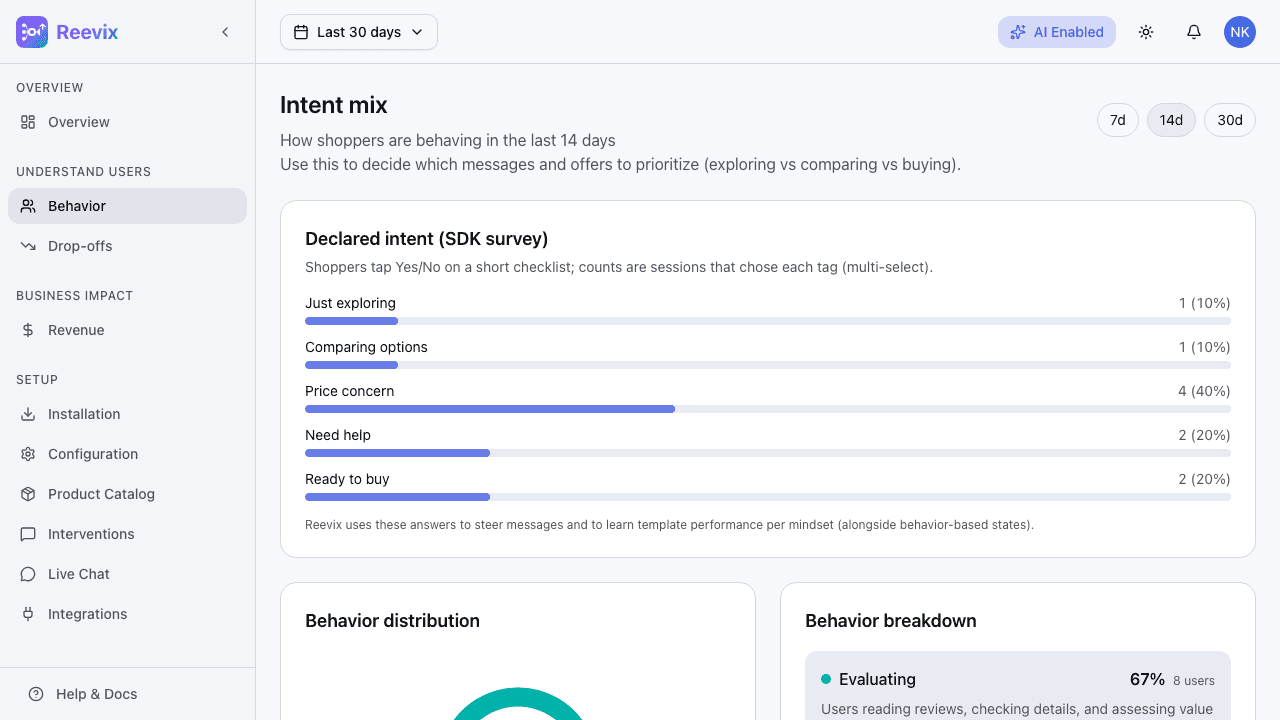
Behavioral signals tell you what a shopper is doing. Declared intent tells youwhy. Reevix's micro-survey captures this data at key decision moments:
- "What's holding you back?" → Price concern / Comparison shopping / Just browsing / Ready to buy
This single data point transforms personalization accuracy. A shopper who declares "price concern" should see value-reinforcing messages, not urgency tactics. A shopper declaring "comparison shopping" needs social proof, not checkout reminders.
Real-Time vs. Post-Session Analytics: The Revenue Impact
Consider two scenarios for a shopper experiencing checkout friction:
Traditional analytics workflow:
- Shopper encounters error → leaves → counted as bounced session
- Data analyst reviews funnel report on Monday
- Friction identified → added to sprint backlog
- Fix shipped 3 weeks later
- Revenue lost: 3 weeks × daily checkout failures
Real-time behavioral analytics workflow:
- Shopper encounters error → rage click detected in real time
- Reevix immediately surfaces "Need help? Chat with us" or alternative payment option
- Shopper completes purchase
- Revenue recovered: immediately
Setting Up Behavioral Analytics: The Reevix Approach
Most behavioral analytics platforms require custom event tagging, data engineering, and weeks of setup. Reevix auto-captures behavioral signals from a single script snippet — no custom event configuration required.
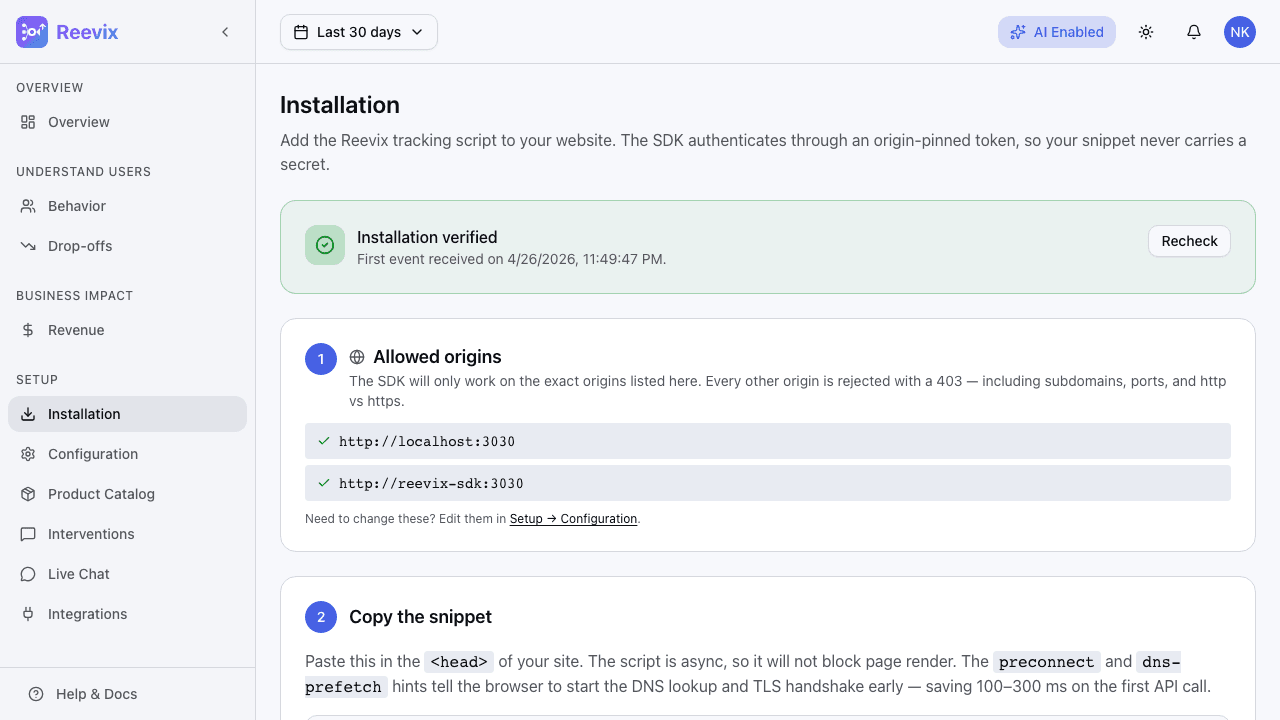
Out of the box, Reevix automatically captures:
- Page views with full path tracking
- Product view events (with viewport-based detection — only counts when product is actually visible)
- Cart interactions
- Checkout progression
- Rage click detection
- Exit intent signals
- Cross-tab session synchronization
- Form error detection
The Behavioral Analytics → Revenue Loop
Behavioral data is only valuable if it drives action. Reevix closes the loop:
- Capture: 40+ behavioral signals tracked in real time
- Classify: ML model assigns behavioral state + intent segment
- Decide: AI selects optimal intervention (or no intervention)
- Deploy: Contextual message delivered in <50ms
- Measure: Outcome tracked (click, conversion, dismiss)
- Learn: Contextual bandit updates models for next interaction
Conclusion
The brands that will win in 2026 are not those with the most data — they're the ones that act on it fastest. Real-time behavioral analytics transforms your store from a passive observation environment into an active, intelligent sales agent that understands every shopper and responds in milliseconds.
Reevix brings this capability to any e-commerce store in 5 minutes, without data engineering, without custom event tracking, and without a team of analysts.