Conversion Funnel Optimization: Fix Every Drop-Off Stage with Data
A 35% drop-off at checkout means you're leaving money on the table. Learn how to identify, diagnose, and fix every leaky stage in your conversion funnel using behavioral data.
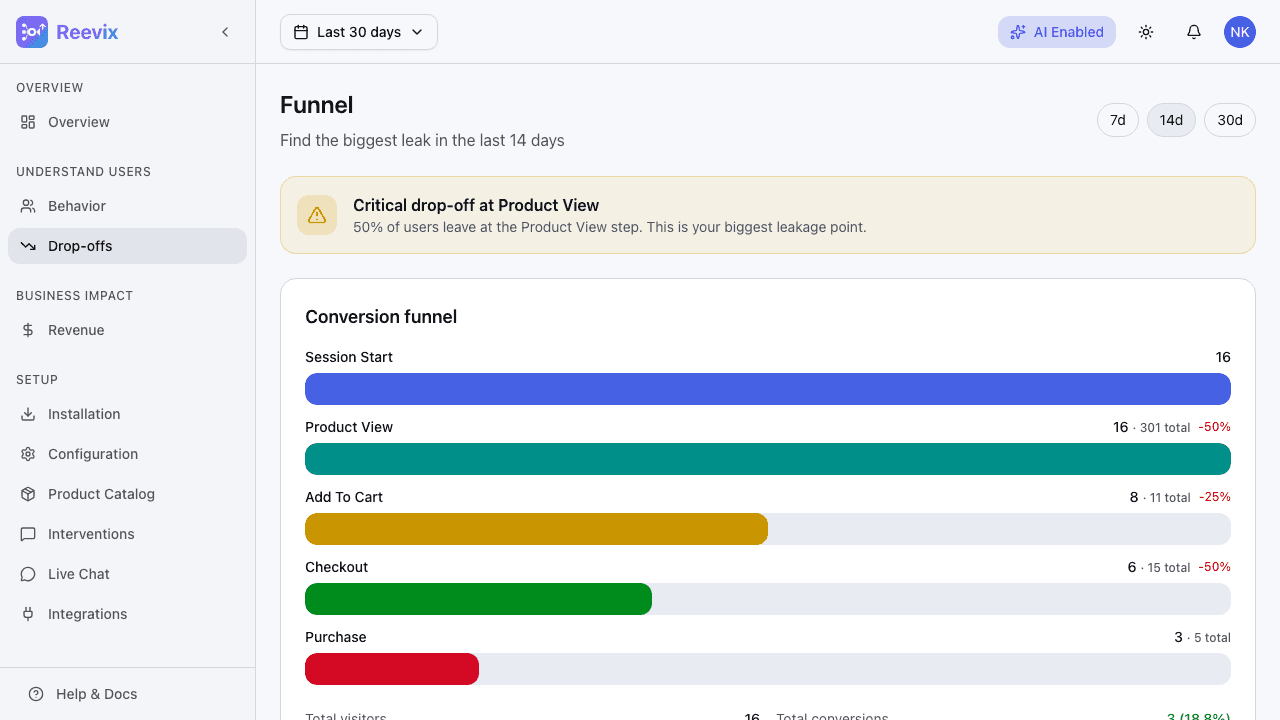
The Anatomy of an E-Commerce Conversion Funnel
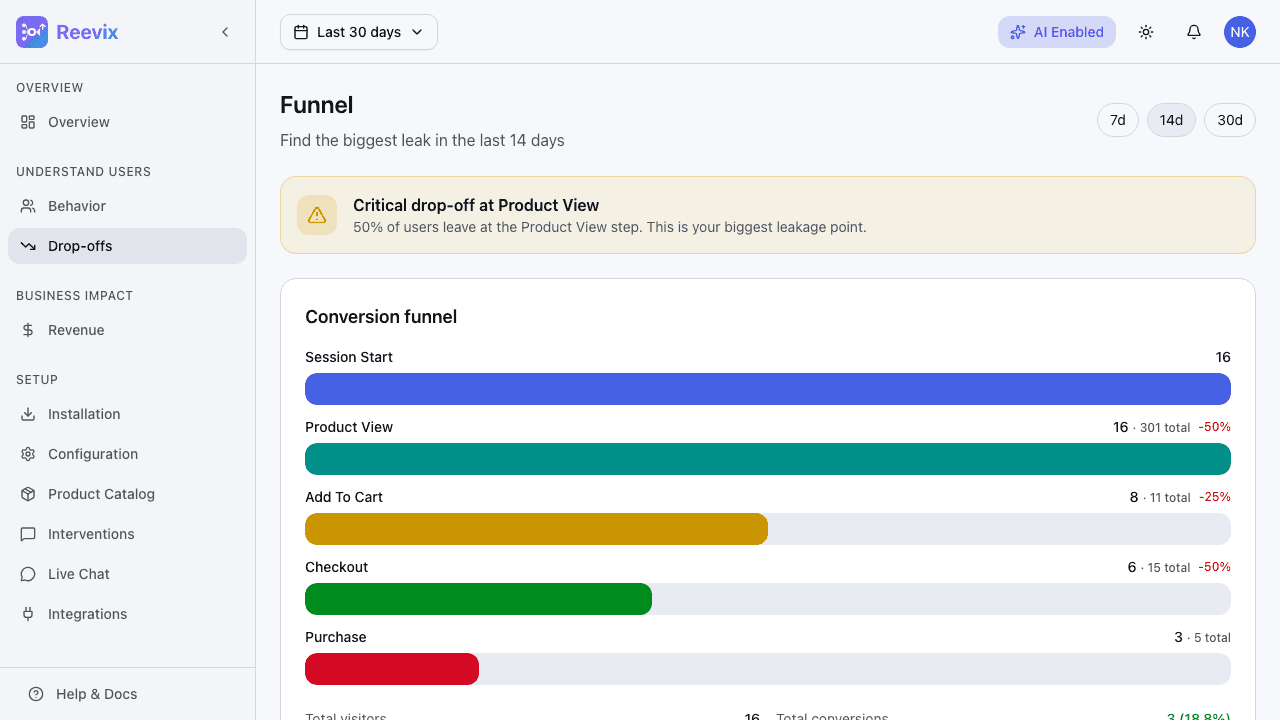
Every e-commerce purchase follows the same five-stage journey: Session Start → Product View → Add to Cart → Checkout Start → Purchase. At each transition, you lose shoppers. The question is: how many, why, and what can you do about it?
Industry benchmarks tell you that most stores convert 1–3% of visitors. What they don't tell you is that most of that loss is preventable — if you can identify the cause at each stage.
Stage 1: Session Start → Product View (Top-of-Funnel)
The Problem
Visitors landing on your homepage or collection pages leave without viewing any product. This is typically a relevance problem — the shopper doesn't immediately see something that matches what they came for.
Diagnosing with Behavioral Data
Reevix identifies the following signals for top-of-funnel drop-offs:
- High scroll depth with no product clicks (content isn't surfacing relevant items)
- Immediate exit after landing (traffic quality or landing page mismatch)
- Filter/search usage without result engagement (poor search relevance)
The Fix
When Reevix detects an exploring shopper who hasn't engaged with any product after 30+ seconds, it surfaces a curated recommendation module — "Top picks based on what browsers like you are viewing" — giving indecisive visitors a starting point.
Stage 2: Product View → Add to Cart
The Problem
This is where most e-commerce revenue is lost. The shopper viewed the product — they were interested enough to click — but didn't add to cart. This is the highest-volume drop-off stage for most stores.
Diagnosing with Behavioral Data
- Extended dwell time without cart add → evaluation hesitation (trust/doubt)
- Multiple views of same product across sessions → high intent, needs final nudge
- Review section engagement without cart add → social proof gap
- Spec section engagement without cart add → information gap
The Fix
For high-dwell evaluators, Reevix deploys trust reassurance messages: return policy highlights, secure purchase badges, customer review counts. For multi-session returners, it shows urgency signals — real stock levels or "You've been eyeing this for X days" personalized messages.
Stage 3: Add to Cart → Checkout Start
The Problem
The shopper added to cart — a strong purchase signal — but didn't start checkout. The cart has become a wishlist. Average drop-off at this stage is 35–45%.
Diagnosing with Behavioral Data
- Cart view without checkout start → cost shock or distraction
- Cart add followed by continued browsing → still in comparison mode
- Multi-item cart with long dwell → decision uncertainty about final selection
The Fix
Reevix's cart persistence prompts appear on the next session for shoppers with abandoned carts — with a direct checkout CTA. For shoppers still comparing, the system switches to decision-facilitation mode: social proof, bestseller indicators, and comparison simplification.
Stage 4: Checkout Start → Purchase (The Critical Mile)
The Problem
The shopper started checkout. They're as close to buying as they can get without actually buying. Yet 23% still abandon here — making checkout abandonment the highest-value recovery opportunity.
Diagnosing with Behavioral Data
- Form field errors → technical friction, needs immediate intervention
- Rage clicks on payment step → payment method friction
- Address form drop-off → too many required fields, friction
- Multiple checkout page views without completion → decision reversal
The Fix
Reevix detects checkout friction signals in real time. Rage click detection on the payment step immediately surfaces "Need help? Chat with us" or "Try a different payment method" — catching the shopper before they abandon.
Setting Up Funnel Monitoring with Reevix
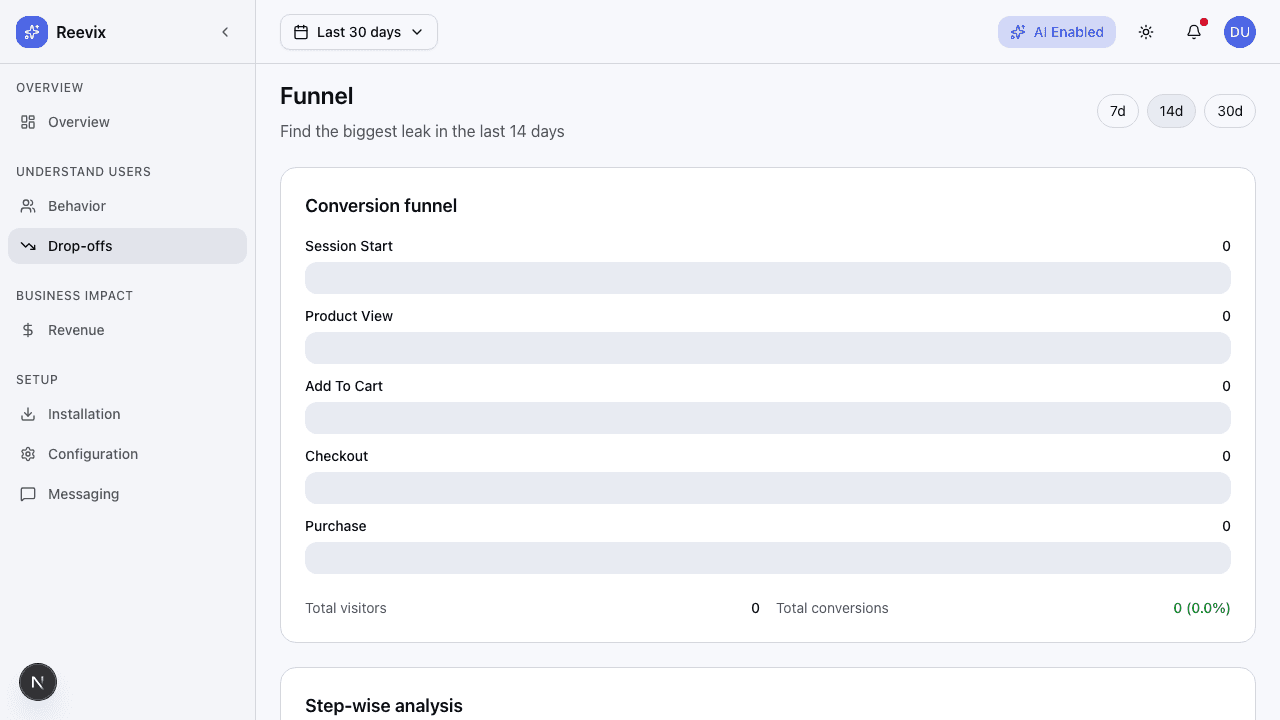
The Reevix funnel dashboard activates automatically from day one of installation. No custom event configuration required — the SDK auto-detects page types and funnel stage transitions.
Critical drop-off alerts (>35% at any stage) are automatically flagged in your dashboard and can trigger notification emails to your team — so you never miss a high-value optimization opportunity.
The Compounding Effect of Funnel Optimization
Here's the math that makes funnel optimization so powerful: each stage improvement compounds. If you improve each of the four transition stages by just 10%:
- Session → Product View: +10% → more products viewed
- Product View → Cart: +10% → more items carted
- Cart → Checkout: +10% → more checkouts started
- Checkout → Purchase: +10% → more completions
The compound effect of four 10% improvements is not 40% — it's 46% more revenue. Funnel optimization is the highest-leverage activity in e-commerce.
Conclusion
Conversion funnel optimization isn't about finding one big fix — it's about systematically reducing friction at every stage, guided by behavioral data that tells you exactly where and why shoppers are leaving.
Reevix gives you the diagnostic tools to identify every leak and the AI-powered intervention system to fix them automatically — turning funnel analysis from a weekly analyst task into a continuous, self-optimizing revenue engine.