AI Shopper Intent Detection: How to Know What Every Visitor Wants
Reevix classifies every shopper into one of four behavioral states in real time — Exploring, Comparing, Evaluating, or Ready to Buy — and automatically deploys the right intervention.
The Problem with "One-Size-Fits-All" E-Commerce
Every visitor to your store is on a different journey. A first-time visitor discovering your brand has completely different needs from a returning customer who already knows exactly what they want. Yet most e-commerce stores show the same homepage, the same CTAs, and the same messages to everyone.
The result? 96% of first-time visitors leave without buying. Not because your product isn't good enough — because the experience wasn't calibrated to where they were in their decision journey.
How AI Intent Detection Works
Reevix's intent detection model combines three signal types into a continuous behavioral profile:
Passive Behavioral Signals
These signals are collected automatically from shopper interactions:
- Product view count and dwell time per product
- Scroll depth and viewport engagement
- Cart add/remove patterns
- Page type progression (home → collection → product → cart)
- Tab visibility and focus/blur cycles
- Rage clicks and form interaction errors
- Cross-session return behavior
Active Intent Signals (Micro-Survey)
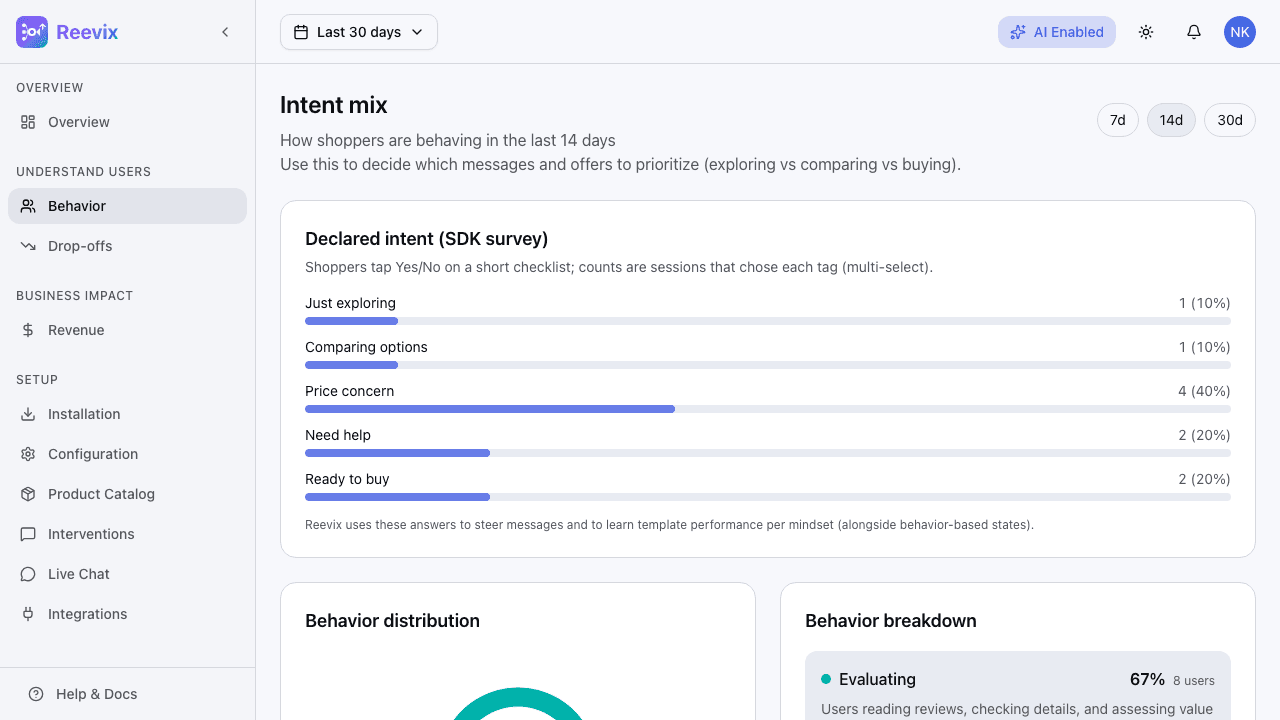
At key decision moments, Reevix surfaces a single-question micro-survey: "What's on your mind right now?" with options like Price concern, Just comparing, Ready to buy, and Need help. This declared intent data supercharges personalization accuracy.
Contextual Page Signals
Reevix auto-detects the page type (Home, Collection, Product, Cart, Checkout) and combines this with the behavioral profile to make page-aware decisions. A shopper in "Comparing" state on a product page gets different treatment than the same shopper in "Comparing" state on a collection page.
The Four Intent States: What They Mean and How to Respond
Exploring → Discovery Assistance
Signals: Short session, many page types visited, no cart activity, low product dwell time.
What they need: Curation and navigation guidance. They don't know what they want yet. Help them find it.
Reevix response: Bestseller collection highlights, category-based popular products, "Our customers love these" social proof modules.
Comparing → Decision Facilitation
Signals: 3+ product views in same category, back-and-forth navigation, filter usage, repeat visits to same products.
What they need: A clear signal about which option is best. Decision fatigue is real — help them choose.
Reevix response: "#1 bestseller in category" overlays, "Most popular choice among [shopper type]" badges, comparison simplification messages.
Evaluating → Trust Building
Signals: Extended single-product dwell time, zoom interactions, review section engagement, multiple product image views, return visits to same product.
What they need: Confidence. They've found their product but are second-guessing the purchase.
Reevix response: Return policy reminders, secure checkout badges, customer review highlights, "X people bought this today" social proof.
Ready to Buy → Friction Removal
Signals: Cart add, checkout start, return session with existing cart.
What they need: A clear, frictionless path to completion. Don't interrupt them with new offers — help them finish.
Reevix response: Checkout progress indicators, saved cart reminders, payment option variety reminders, express checkout nudges.
The Compound Effect of Intent-Aware Personalization
Deploying the wrong message at the wrong intent stage doesn't just fail to convert — it actively harms your metrics. An aggressive discount popup shown to a shopper already in "Ready to Buy" state teaches your customers to wait for discounts, destroying margins.
Intent-aware personalization respects the shopper's journey:
- High-intent shoppers see full-price nudges → margins protected
- Price-sensitive explorers see value messaging → conversions improved
- Evaluators see trust content → anxiety reduced
- Comparers see social proof → decisions accelerated
Privacy-First Intent Detection
A critical concern with any behavioral tracking technology is privacy compliance. Reevix's intent detection is fully GDPR and CCPA compliant:
- No PII collected: Intent signals are anonymized behavioral patterns, not personal data
- No cross-site tracking: Data stays within your store's domain
- No consent banner required: Behavioral analytics of your own site visitors doesn't require explicit consent under GDPR Article 6
- Cookie-less: Uses localStorage and session reconciliation, not third-party cookies
Getting Started with Intent Detection
Intent detection in Reevix requires zero configuration to start. Install the script, and the behavioral classification model begins building shopper profiles immediately. You'll see your first intent distribution data within 24 hours of installation.
The behavioral state and intent mix data in your dashboard will immediately surface insights: which intent segments are most prevalent, which states have the highest drop-off rates, and where your biggest conversion opportunities lie.