The Complete Guide to Cart Abandonment Recovery in 2026
Over 70% of online shoppers abandon their carts before purchasing. Learn the psychology behind abandonment and the AI-powered techniques that recover 15–30% of lost revenue automatically.
What Is Cart Abandonment — And Why It Costs You So Much
Every online store faces the same brutal reality: the average cart abandonment rate sits at 70.19% across all industries (Baymard Institute, 2026). That means for every ten shoppers who add something to their cart, seven leave without buying.
For a store doing $500K/year in revenue, fixing cart abandonment isn't a "nice to have" — it's a $1M+ opportunity sitting idle in your funnel.
The Six Root Causes of Cart Abandonment
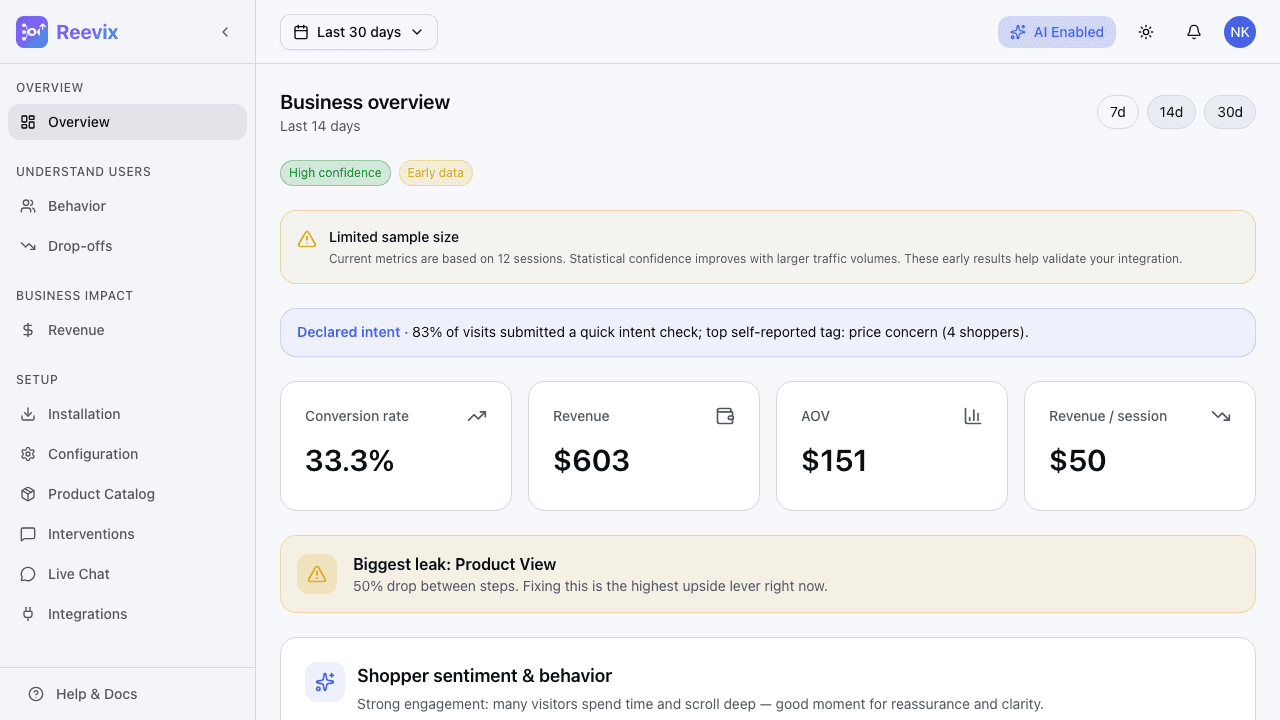
Not all abandonment is equal. Reevix's behavioral analysis across thousands of stores identifies six distinct abandonment patterns, each requiring a different recovery strategy.
1. Price Shock at Checkout
49% of abandonment happens when shoppers see unexpected costs — shipping fees, taxes, or service charges that weren't visible earlier. The shopper was ready to buy, then felt deceived.
Recovery tactic: Show total cost transparency earlier in the journey. Reevix detects when a shopper reaches checkout and has previously viewed the cart multiple times (a hesitation signal) — it then proactively surfaces a "Free shipping on orders over $X" nudge before the shopper reaches the shock moment.
2. Comparison Mode Paralysis
When a shopper views 5+ products without adding to cart, they're in comparison mode. They're not abandoning because they don't want to buy — they're abandoning because they can't decide. Generic CTAs don't help.
Recovery tactic: Reevix detects this state and deploys contextual social proof — bestseller badges, "Most popular choice" overlays, or "See what others in your city bought" — to give the comparison-paralyzed shopper a clear signal.
3. Trust Deficit
First-time visitors abandon at 2.4× the rate of returning customers. They don't know your brand. They're not sure if their card data is safe. They wonder if the return policy is fair.
Recovery tactic: When Reevix identifies a first-visit behavioral pattern with extended hover time on product images (uncertainty signal), it deploys trust reassurance messages: secure checkout badges, return policy reminders, and customer review counts.
4. Distraction / "Save for Later" Intent
Not every abandonment is negative. ~24% of abandonments are "save for later" — the shopper genuinely intends to return. They're using their cart as a wishlist.
Recovery tactic: For shoppers showing this pattern (multiple sessions, cart adds without checkout starts), Reevix triggers a "Your cart is waiting" persistence message with a direct checkout link on the next session.
5. Technical Friction
Rage clicks, form errors, and checkout stalls are measurable friction signals. If a shopper clicks the "Place Order" button three times in five seconds, something is broken — and they're about to leave forever.
Recovery tactic: Reevix's rage-click detection fires an immediate intervention — a support prompt, an alternative payment option, or a simplified checkout flow suggestion.
6. Forced Account Creation
34% of shoppers abandon when forced to create an account before checkout. This is the most avoidable abandonment cause — and the easiest to fix.
The AI-Powered Recovery Stack
Traditional cart recovery relies on two tools: retargeting ads and abandonment emails. Both are reactive — they trigger after the shopper has already left. Reevix operates differently: it prevents abandonment in real time, before the customer leaves.
Here's how the Reevix recovery stack works:
Layer 1: Intent Detection (Pre-Abandonment)
The system monitors 40+ behavioral signals simultaneously. When it detects a high-risk abandonment pattern — extended cart dwell time, mouse moving toward browser close button, repeated back-button taps on mobile — it immediately queues a recovery intervention.
Layer 2: Contextual Intervention (Real-Time)
The intervention deployed isn't generic. It's matched to the abandonment cause the AI has identified:
- Price concern signal → Price match guarantee or discount offer
- Comparison signal → Social proof and bestseller indicators
- Trust signal → Security badges and return policy reminder
- Friction signal → Live chat offer or simplified checkout prompt
Layer 3: Adaptive Learning (Continuous)
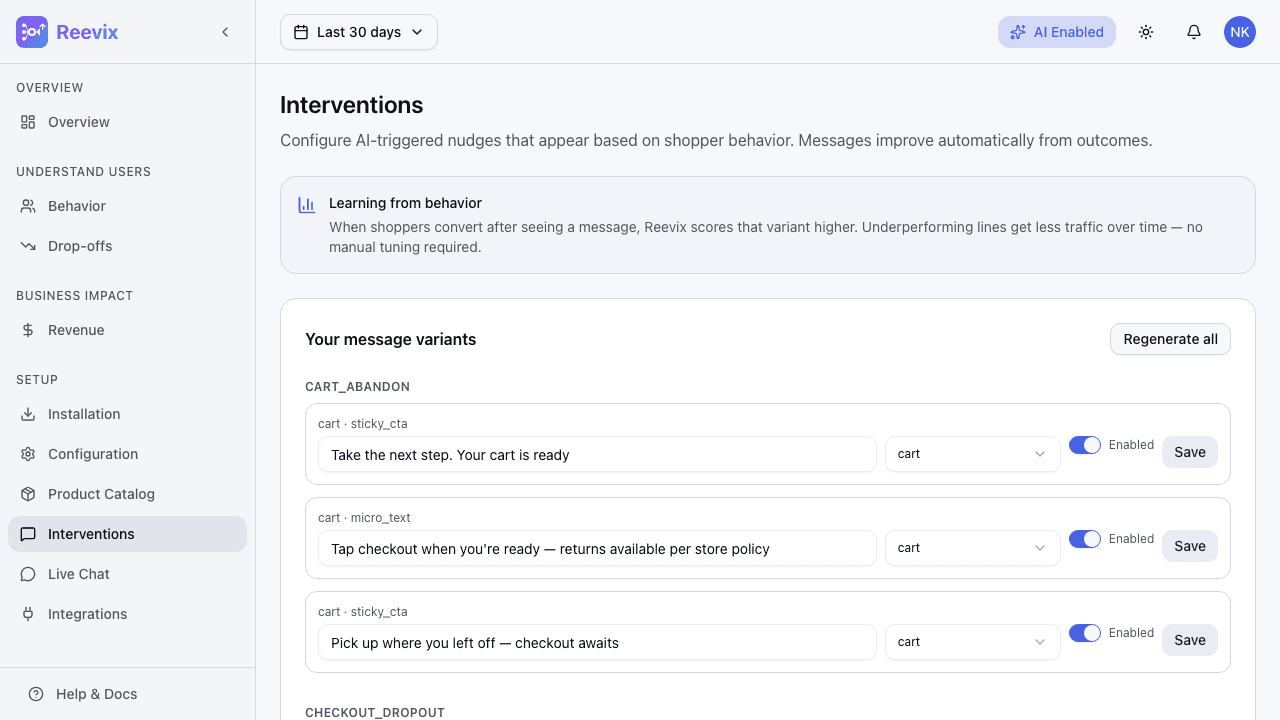
Reevix's contextual bandit algorithm tracks which interventions work best for which shopper segments. A "Free returns" message might outperform "Limited stock" for price-sensitive shoppers, while the reverse is true for FOMO-driven segments.
The system continuously reallocates impressions toward winning variants — automatically, without manual analysis.
Measuring Cart Abandonment Recovery ROI
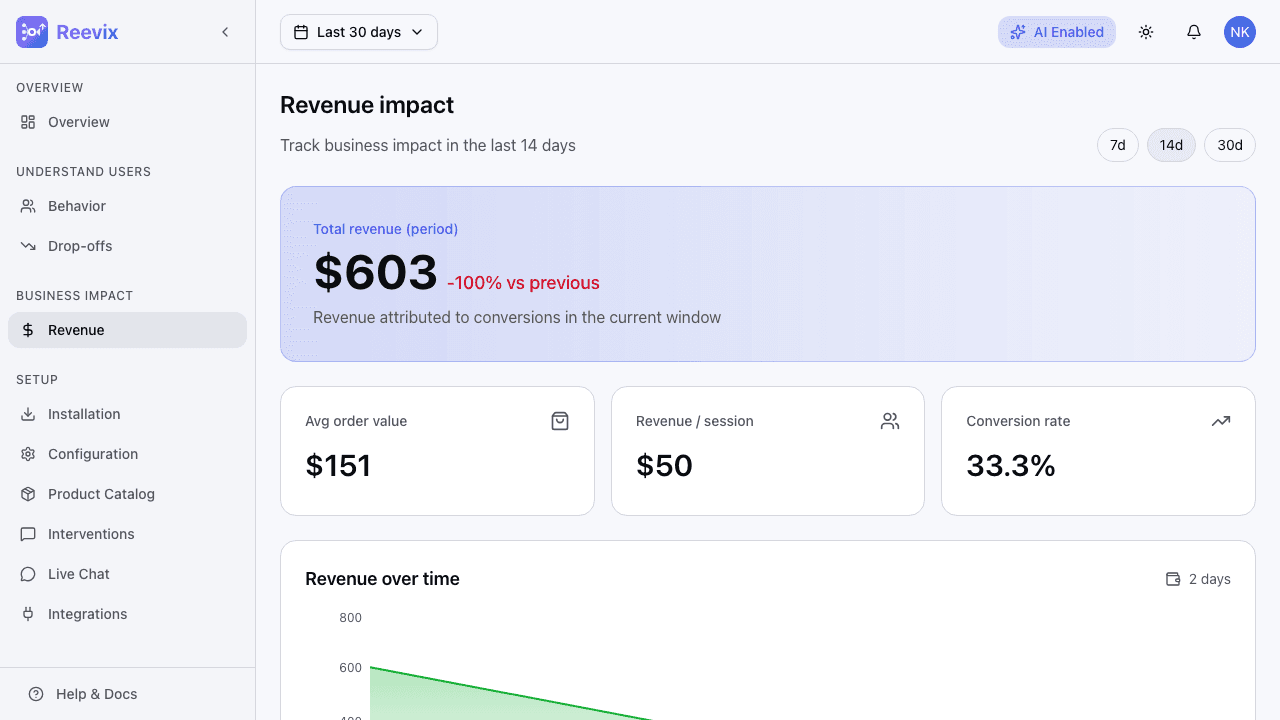
The Reevix revenue dashboard gives you direct attribution for every recovery intervention. You can see exactly how much revenue was recovered from each behavioral trigger, broken down by traffic source, device type, and shopper segment.
Implementation: 5 Minutes to Your First Recovery
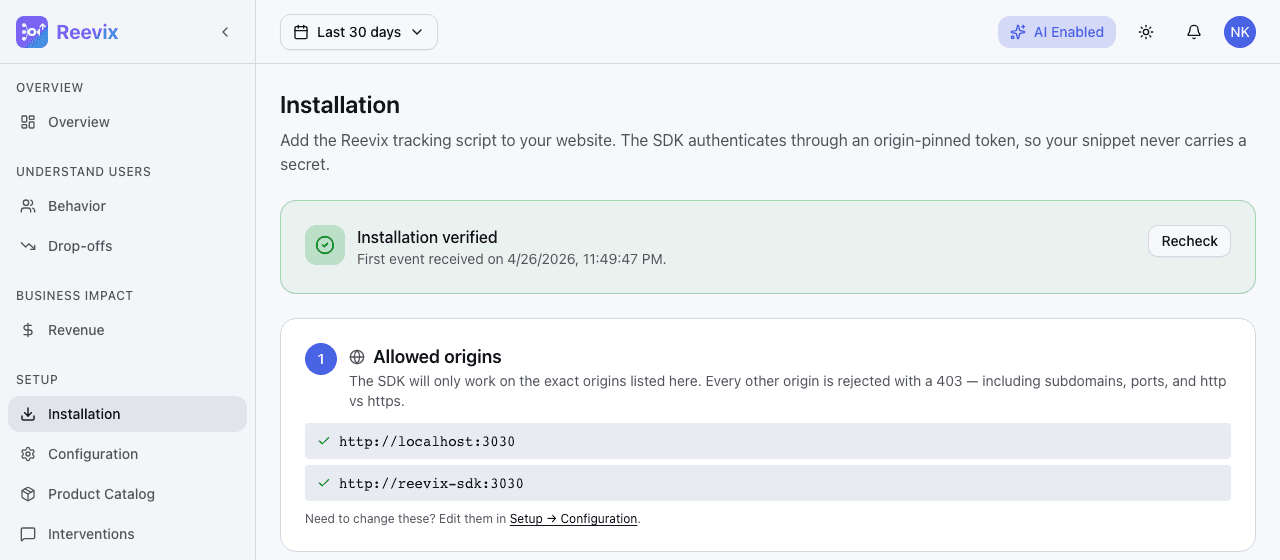
Unlike Optimizely or Dynamic Yield which require weeks of integration, Reevix is a single script snippet. Paste it before your </body> tag, configure your domain, and abandonment recovery activates immediately.
Cart Abandonment Recovery Best Practices for 2026
- Be pre-emptive, not reactive. The best recovery happens before abandonment, not after. Real-time detection beats email retargeting every time.
- Match intervention to cause. A blanket 10% discount applied to all abandoning shoppers is margin destruction. Use behavioral signals to identify who needs what.
- Test relentlessly. Your best-performing recovery message today will be outperformed in 90 days. Continuous A/B testing via contextual bandits compounds improvements automatically.
- Track attribution precisely. If you can't prove which recovery tactic generated which revenue, you can't optimize. Holdout groups give you statistical proof.
- Respect the shopper. Over-aggressive recovery (popups on every page, countdown timers everywhere) creates negative brand associations. Let behavioral AI calibrate the right frequency.
Conclusion
Cart abandonment is not a problem you solve once — it's a continuous optimization challenge. The brands winning in 2026 are those that have moved from reactive (retargeting after the fact) to proactive (intervening in real time based on behavioral intent signals).
Reevix automates the entire recovery stack: detecting abandonment intent, deploying the right contextual message, learning from outcomes, and attributing recovered revenue — all without any manual work on your part.