E-Commerce A/B Testing in 2026: Why Static Tests Are Costing You Revenue
Traditional A/B testing takes weeks and ignores real-time context. Contextual bandits learn continuously, auto-promote winners, and compound improvements — here's how to leverage them.
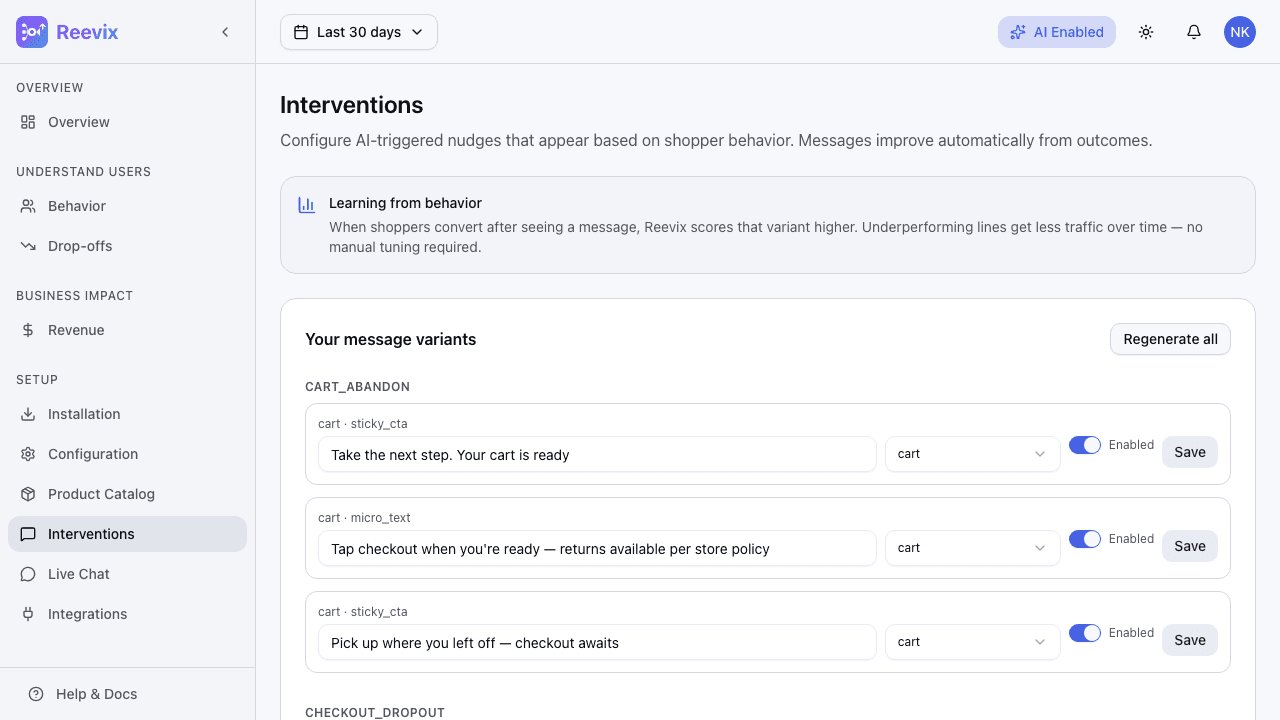
The Hidden Cost of Traditional A/B Testing
Traditional A/B testing works like this: you hypothesize a change, split your traffic 50/50, run the test for 2–4 weeks to achieve statistical significance, analyze the results, and then implement the winner. Repeat.
Here's the math problem: while you're running that test, 50% of your traffic is experiencing the loser. If the winning variant converts 15% better and your test runs for 3 weeks at 50K visitors per week, you've sacrificed the conversion of ~3,000 additional customers to learn something that a smarter algorithm could have discovered in days.
How Contextual Bandits Outperform Traditional A/B Tests
A contextual bandit is an algorithm that continuously allocates traffic between variants based on their real-time performance — maximizing conversions during the learning process, not just after it concludes.
The key differences from traditional A/B testing:
1. No Pre-defined Test Duration
Traditional A/B tests require a pre-defined sample size to achieve the desired statistical power. Bandits adapt continuously — there's no "end date" where you flip to the winner. The winner emerges automatically as traffic allocations shift.
2. Context-Aware Winning
Traditional A/B tests find a winner "on average." Contextual bandits find the winnerfor each specific context. Variant A might be best for mobile users in evaluation mode, while Variant C is best for desktop users in comparison mode. A static test can't surface this nuance.
3. Continuous Learning, No Cold Starts
After a traditional A/B test concludes and you implement the winner, you've stopped learning. A bandit never stops — it continuously tests underperforming variants at a low exploration rate (typically 10–15%), so if seasonal changes or traffic mix shifts make a previously losing variant competitive again, it gets rediscovered automatically.
The Epsilon-Greedy Algorithm Explained
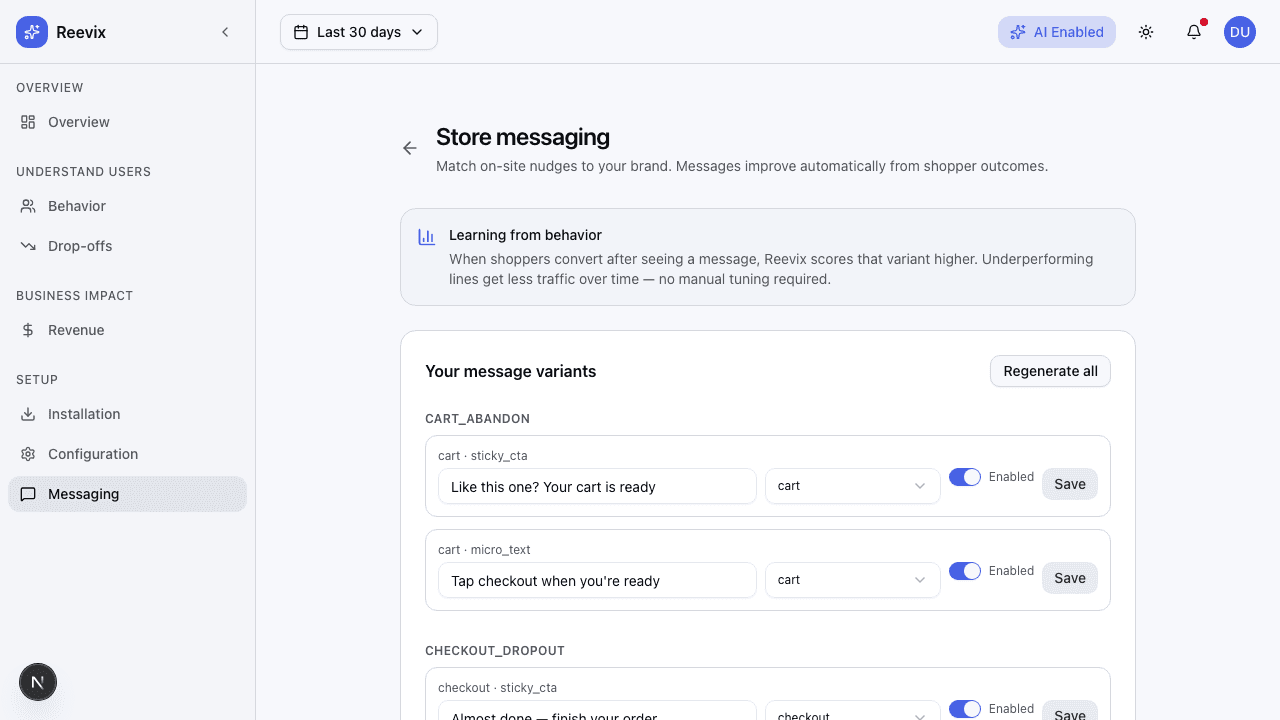
Reevix uses an epsilon-greedy bandit for message variant selection. Here's how it works:
- ε (epsilon) = 0.15 — 15% of impressions go to random variant exploration
- 1 - ε = 0.85 — 85% of impressions go to the current best performer
This creates a balance: you capture most of the conversion benefit from the current best variant while continuously testing whether any variant has improved or conditions have changed.
As the system accumulates more outcome data, the confidence in each variant's performance increases — and the effective "winner margin" becomes more pronounced.
Setting Up Message Variant Testing in Reevix
Creating a bandit test in Reevix requires no statistical knowledge — just create multiple message variants for a given behavioral state and page type context:
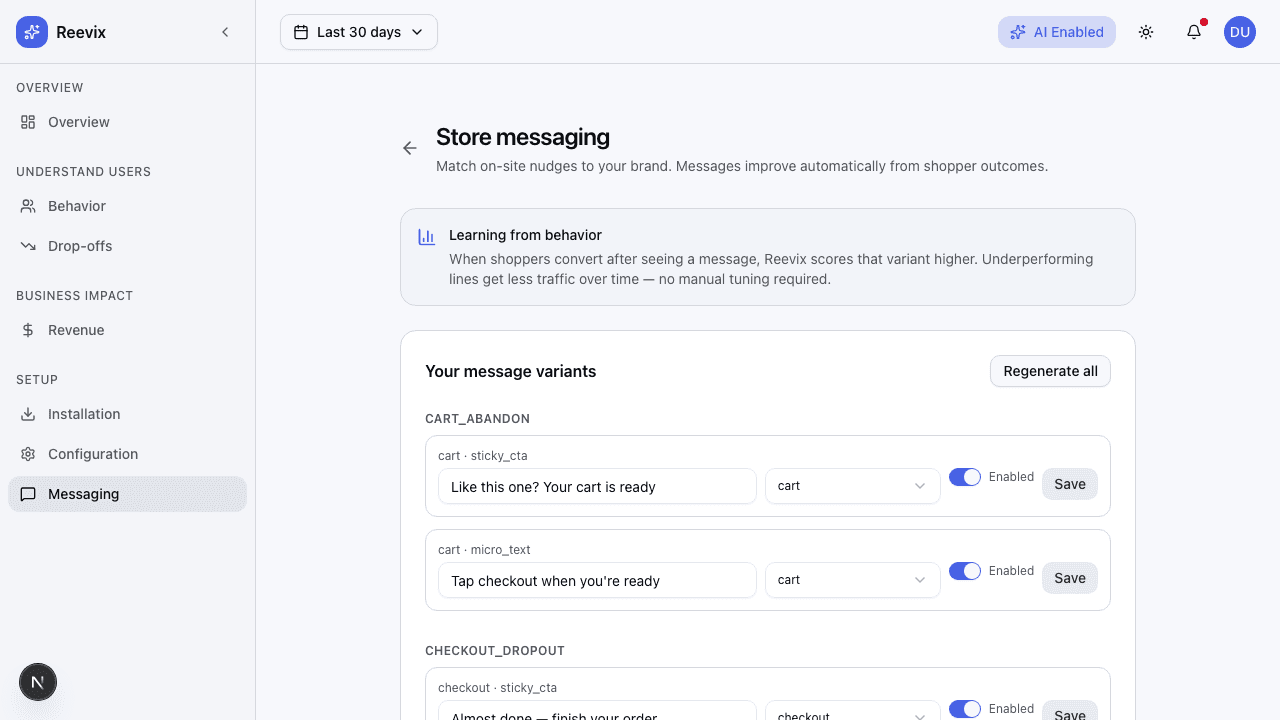
For a Product page + Evaluating state combination, you might create three variants:
- Variant A: "Free returns on all orders — shop with confidence"
- Variant B: "Join 12,000+ happy customers — verified reviews"
- Variant C: "In stock and ships today — order in the next 3 hours"
The bandit begins allocating equally among all three, then shifts allocation as conversion outcome data accumulates. No manual analysis. No test duration decisions. No spreadsheets.
AI-Generated Variant Suggestions
Reevix's AI can generate new variant suggestions based on your product catalog context, behavioral state, and brand voice — expanding your test options without requiring copywriting effort.
Measuring Bandit Performance vs. Traditional Tests
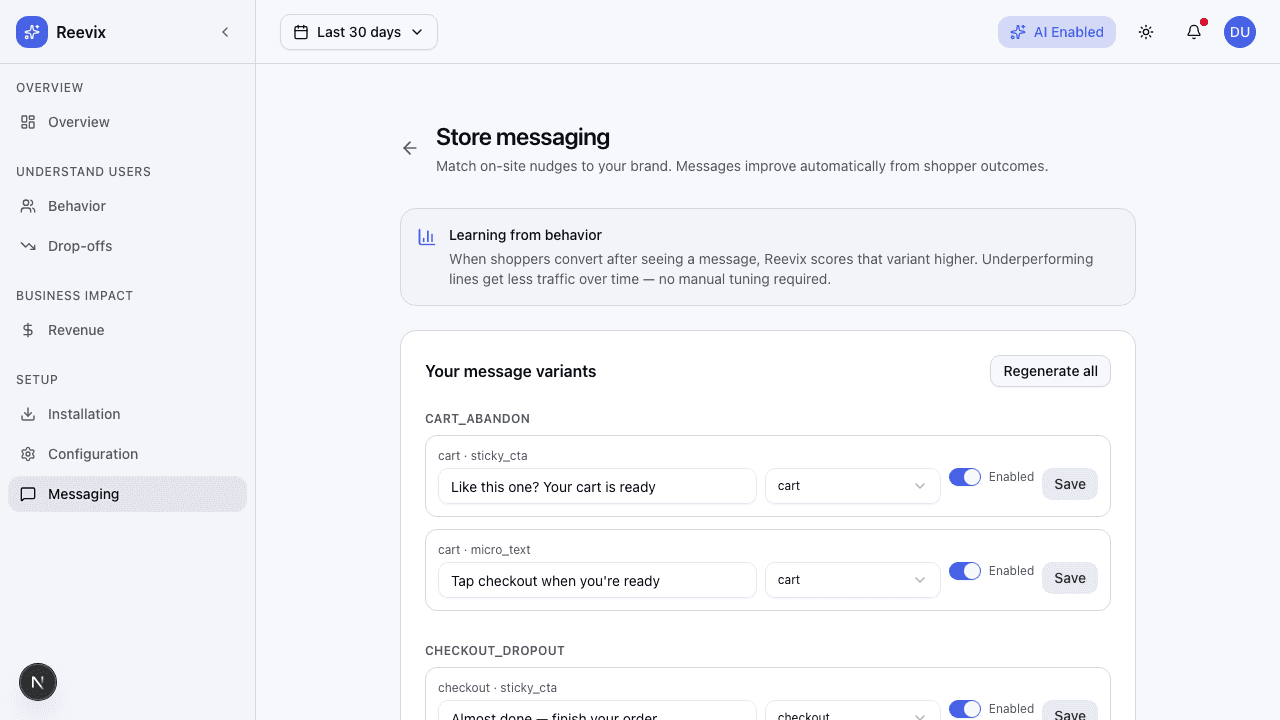
To compare bandit performance against a hypothetical traditional A/B test baseline, Reevix tracks:
- Cumulative regret: Revenue left on the table by showing non-optimal variants
- Convergence speed: How quickly the best variant reaches dominant allocation
- Context diversity: How many distinct context + variant winner combinations have been discovered
These metrics are visible in your messaging analytics — allowing you to quantify the learning efficiency of your bandit configuration.
When Traditional A/B Testing Still Makes Sense
Contextual bandits aren't superior in every scenario. Traditional A/B testing remains the right choice for:
- Major page redesigns: Testing a completely new checkout flow vs. old requires clean, equal traffic splits for unambiguous causality
- Regulatory/compliance changes: Where you need documented test evidence for stakeholders
- Single, high-traffic hypothesis tests: If you have 1M visitors/week and want to answer one question fast, a simple A/B is appropriate
For message optimization, offer testing, and intervention variant selection — the continuous, context-aware nature of bandits wins every time.
Conclusion
The opportunity cost of traditional A/B testing compounds silently. Every week you run a static 50/50 test, you're sacrificing the conversions that a smarter algorithm would have captured.
Contextual bandits turn testing from a discrete, periodic activity into a continuous optimization process that never sleeps, never requires manual analysis, and gets smarter with every interaction.