E-Commerce Revenue Attribution: How to Prove Which Optimizations Actually Work
Stop guessing which changes move revenue. Learn how AI-powered holdout groups and attribution modeling give you statistical proof of ROI for every optimization you deploy.
The Attribution Problem in E-Commerce
You launched a new checkout flow redesign. Conversions went up 8% the following week. Was it the redesign? Or the email campaign you also sent that week? Or seasonal demand? Or the competitor who went out of stock?
Without rigorous attribution, every optimization looks like it works — until you remove it and nothing changes. Conversely, genuinely high-impact changes get deprioritized because their effect was masked by noise.
The Gold Standard: Holdout Groups
The only statistically rigorous way to measure the impact of a behavioral intervention is the holdout group (also called control group or counterfactual measurement).
Here's how it works:
- When an AI intervention is triggered for a qualifying shopper, a random sample (~10%) is placed in the holdout group
- Holdout shoppers see no intervention — they experience your store without the AI
- Both groups are tracked through to conversion
- The conversion rate difference between treatment and holdout = intervention impact
This approach controls for seasonality, traffic mix changes, and any other factors that might confound the measurement — giving you a clean, defensible number.
Multi-Touch Attribution for E-Commerce
A single purchase often involves multiple interventions across multiple sessions. Attribution models determine how to assign credit for the final conversion:
Last-Touch Attribution
100% of credit goes to the final interaction before purchase. Simple, but misleading — it ignores all the earlier touchpoints that built purchase intent.
First-Touch Attribution
100% of credit goes to the first interaction. Better for understanding acquisition channels, but misses the role of mid-funnel optimization.
Linear Attribution
Credit distributed equally across all touchpoints. More balanced, but doesn't reflect that some touchpoints are more causally important than others.
Data-Driven Attribution (Reevix's Approach)
Using the holdout group methodology, Reevix measures the counterfactual impactof each intervention type — not just which interactions happened before conversion, but which ones actually caused conversion.
Understanding the Reevix Revenue Dashboard
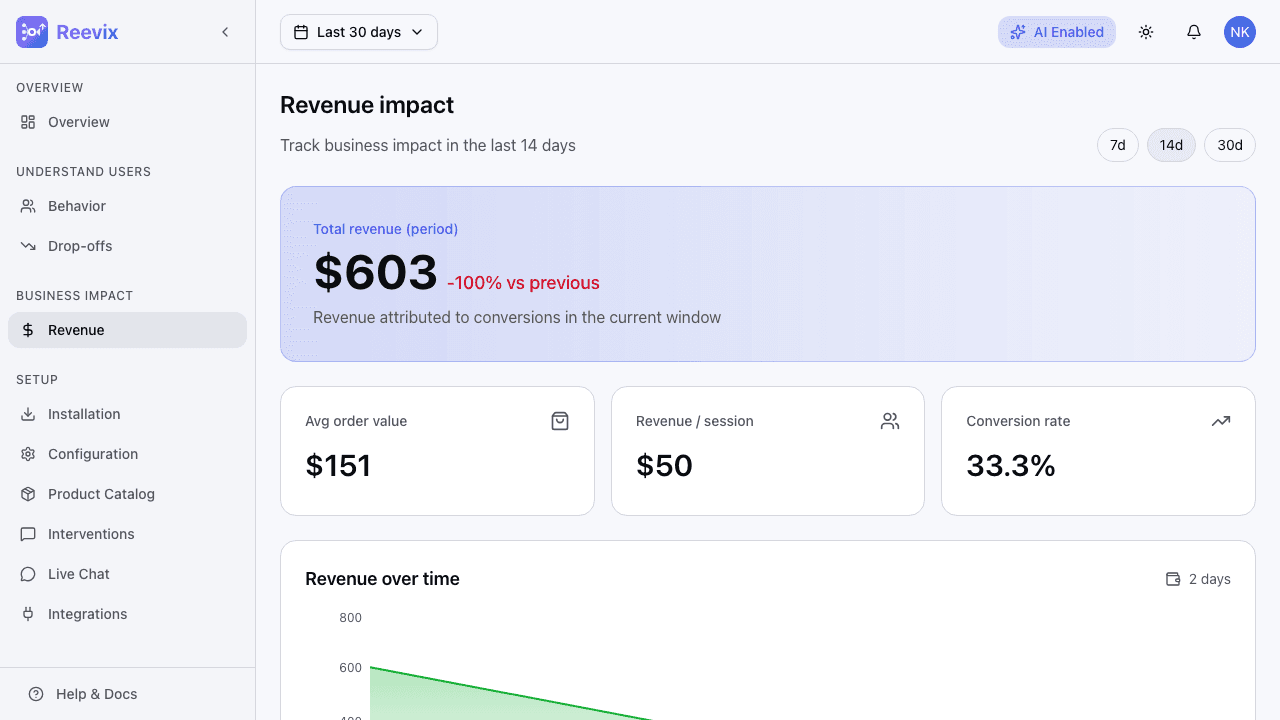
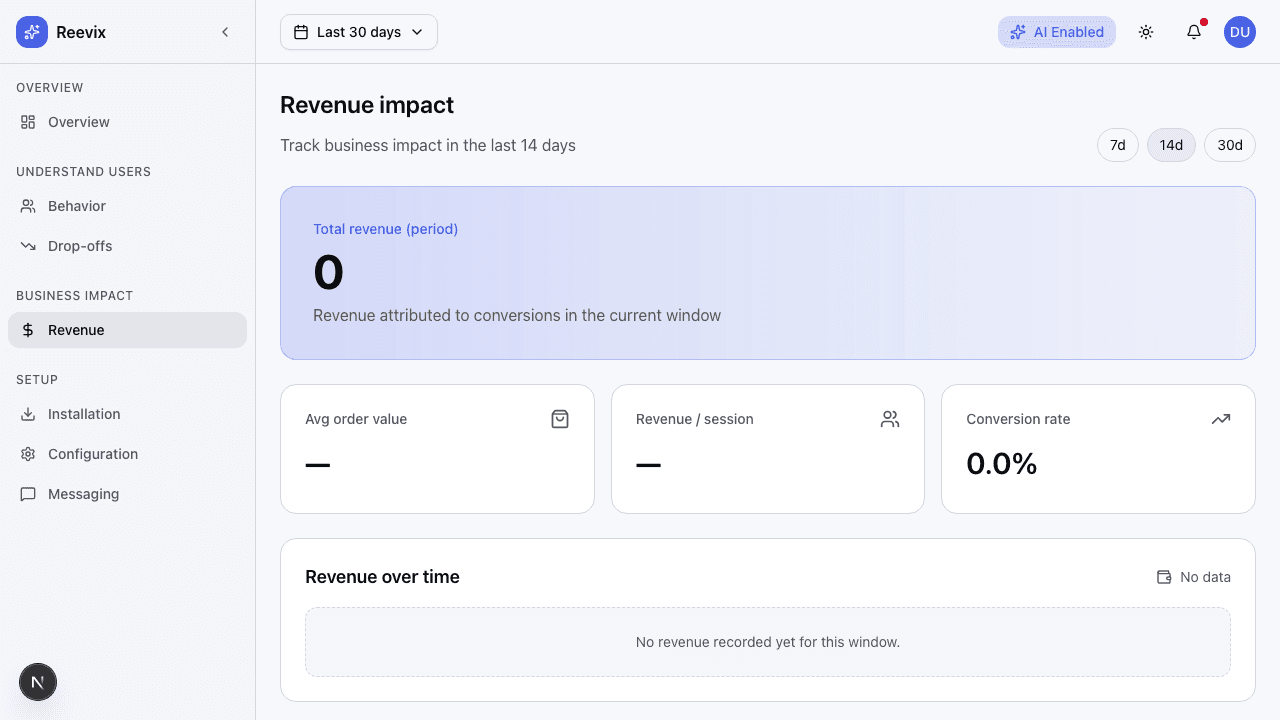
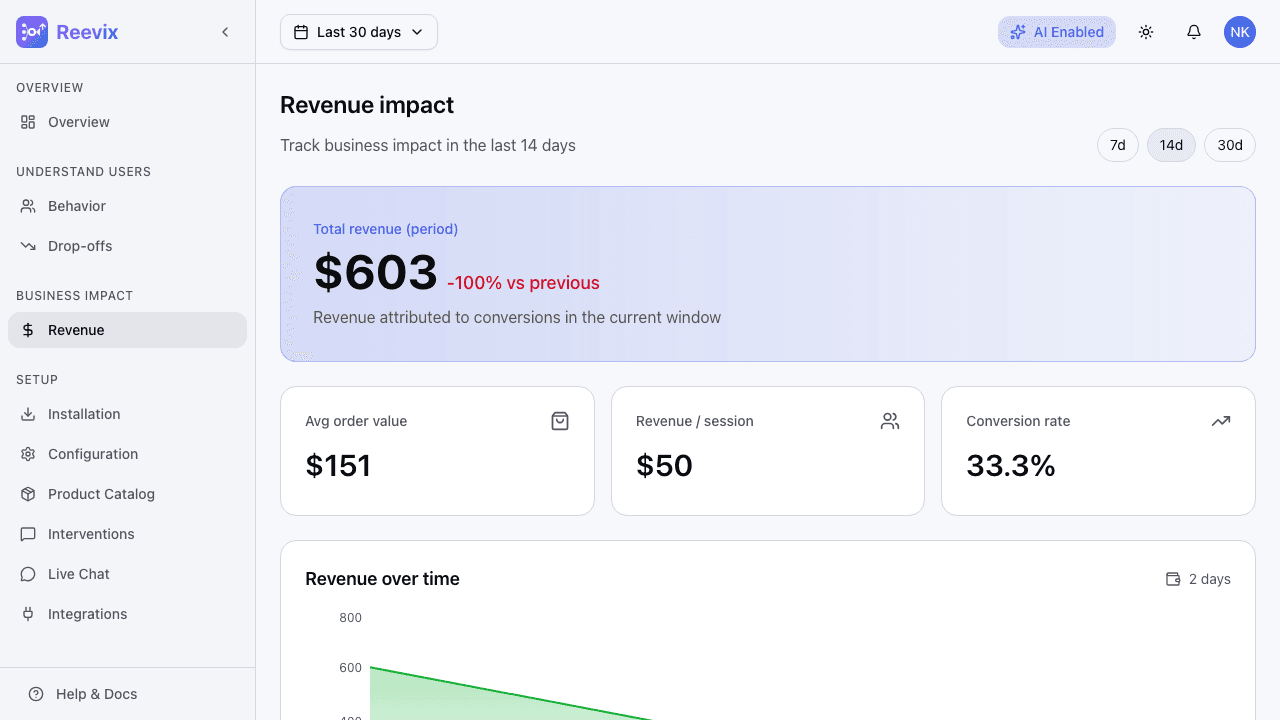
The Reevix revenue dashboard surfaces four key attribution metrics:
1. Total Revenue & Trend
Your gross revenue with period-over-period comparison — the "north star" metric that all optimization work should ultimately move.
2. AI-Attributed Revenue
Revenue that came from sessions where an AI intervention was deployed and the holdout group shows a statistically significant uplift vs. control.
3. Revenue by Traffic Source
Conversion rates and revenue contribution broken down by organic, paid, direct, and influencer/creator traffic — showing which acquisition channels convert most efficiently.
4. Average Order Value (AOV) Trend
AOV over time — critical for measuring the impact of upsell interventions and cart value optimization.
Setting Up Revenue Attribution in 5 Minutes
Reevix automatically tracks purchase events when the SDK detects a successful order confirmation page. For stores with non-standard confirmation pages, you can fire a manual conversion event:
// Reevix manual conversion tracking
window.rvx('conversion', {
  revenue: 149.99,
  currency: 'USD',
  orderId: 'ORD-12345'
})
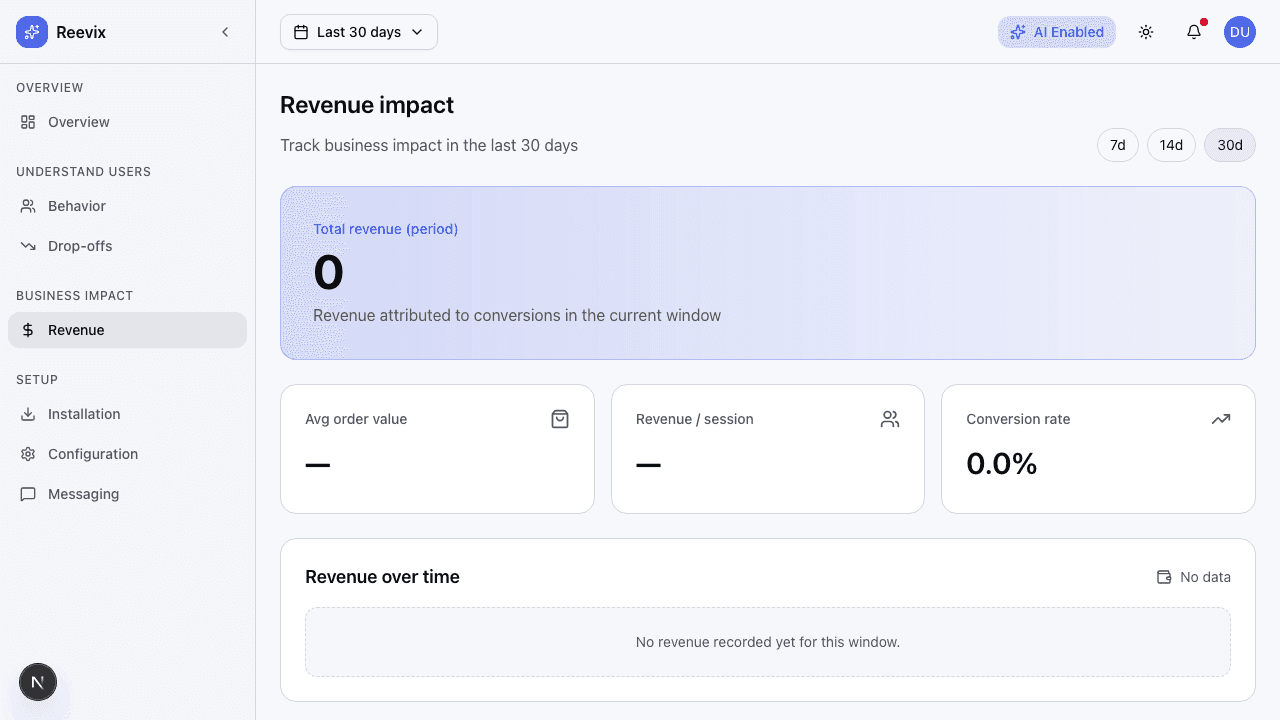
Once conversion tracking is active, revenue attribution populates automatically — no additional configuration required.
Proving ROI to Stakeholders
The holdout group methodology provides the most defensible ROI calculation for any stakeholder:
- Treatment conversion rate: 3.8%
- Holdout conversion rate: 3.0%
- Lift: 0.8 percentage points (26.7% relative improvement)
- Statistical confidence: 97.3%
- Revenue attribution: (lift × sessions × AOV) = provable monthly revenue
This is not correlation — it's causation. The holdout group proves that the revenue improvement would not have happened without the AI interventions.
Conclusion
Revenue attribution transforms CRO from an act of faith into a science. When you can prove — with statistical rigor — that your optimizations are generating specific revenue numbers, you can justify investment, prioritize effort, and build a compounding optimization machine.
Reevix builds rigorous attribution into the platform by design — because an optimization tool that can't prove its own ROI isn't worth your investment.