7 Proven Techniques to Reduce E-Commerce Bounce Rate Using AI
High bounce rates signal a mismatch between visitor expectations and your page experience. These data-backed techniques address each cause — and Reevix automates all of them.
What Your Bounce Rate Is Really Telling You
A 65% bounce rate doesn't mean 65% of your visitors "didn't like" your store. It means 65% of visitors had a session that consisted of exactly one page view. That's a very different thing — and requires a very different diagnosis.
Some bouncers are in-market visitors who found what they needed on page one and converted elsewhere. Others are misrouted traffic from poorly targeted ads. Others hit friction — slow load times, confusing navigation, or a complete mismatch between what the ad promised and what the page delivered.
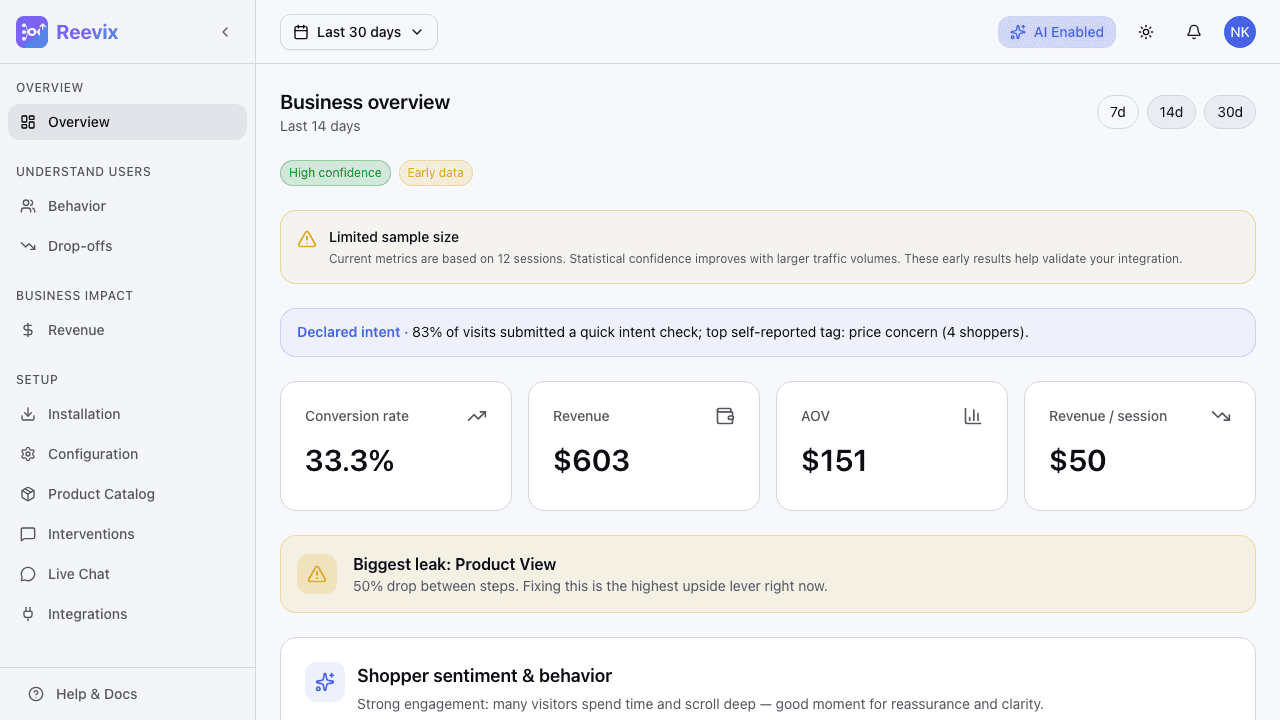
The key is behavioral diagnosis: why are your specific visitors bouncing? Reevix's behavioral analytics surfaces the signal patterns that precede bounce events — giving you a cause-and-fix map rather than a raw rate.
Technique 1: Eliminate Above-the-Fold Confusion
The #1 cause of high bounce rates on homepages and collection pages is the "what do I do next?" moment. The shopper lands, doesn't immediately understand where to navigate, and leaves.
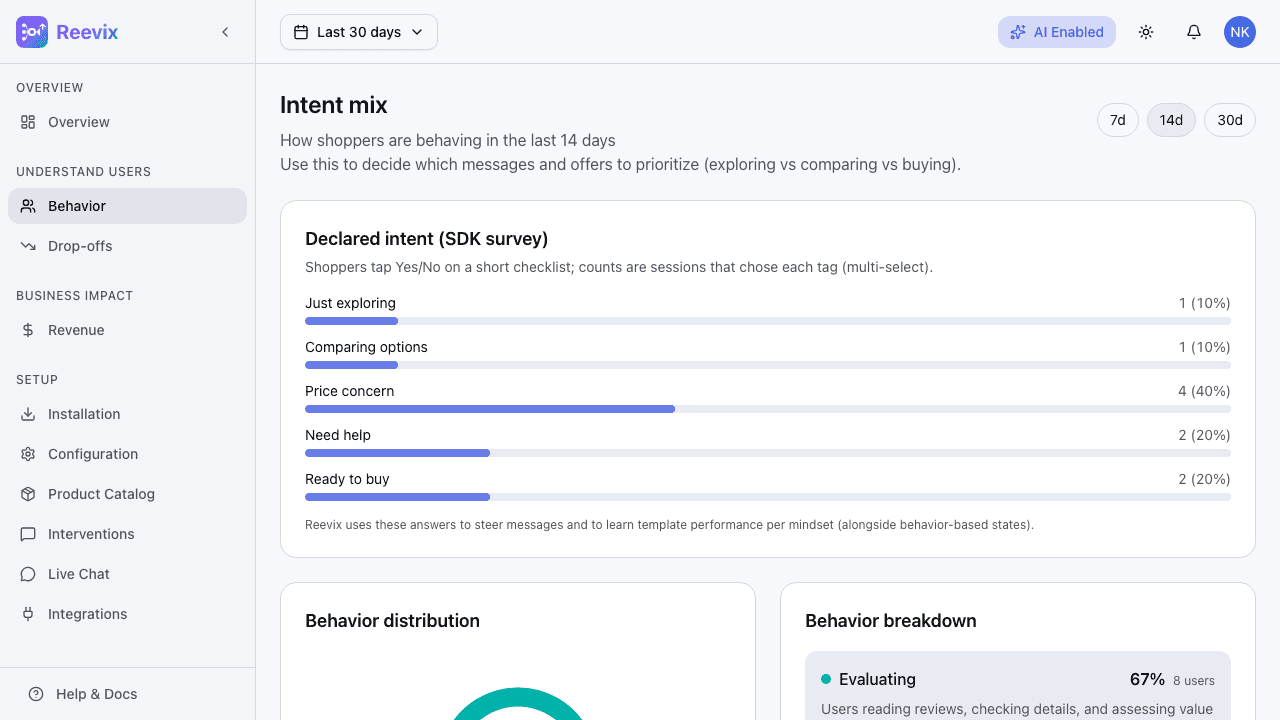
Reevix's approach: When it detects an exploring shopper who scrolls but doesn't click within the first 15 seconds, it surfaces a guided navigation module — "Tell us what you're looking for" — to help the visitor self-sort into a product category.
Technique 2: Match Landing Page to Ad Promise
Traffic source mismatch is the second most common bounce cause. A paid ad promising "50% off running shoes" that leads to a general footwear homepage will bounce at 80%+.
Reevix's approach: UTM parameter detection identifies the traffic source and the page type. High bounce rates from specific sources surface in your analytics, giving you precise data to fix the landing page targeting issue.
Technique 3: Intercept Exit Intent Before It Completes
Exit intent detection — tracking mouse movement toward the browser close button or back button — gives you a 1–3 second window to deploy a recovery message before the visitor leaves.
Reevix's approach: Exit intent is detected as part of the behavioral signal stream. When detected alongside product view history, a contextual retention message deploys — one that's relevant to what the shopper was viewing, not generic.
Technique 4: Reduce First-Visit Anxiety with Social Proof
First-time visitors bounce at 2.4× the rate of returning customers. The primary driver: trust deficit. They don't know if your store is legitimate, if your products are quality, or if their payment data is safe.
Reevix's approach: First-visit detection triggers trust signal deployment — customer review counts, "as seen in" press mentions, secure checkout badges, and return policy highlights — at the moment of maximum uncertainty.
Technique 5: Fix Mobile Friction Immediately
Mobile bounce rates average 12–15 percentage points higher than desktop. The causes are well-known: small tap targets, slow image loads, complex navigation on small screens, and checkout forms optimized for keyboards.
Reevix's approach: Device type is captured in every behavioral event. Rage click detection on mobile (tapping the same element multiple times) immediately surfaces a simplified interaction prompt — "Having trouble? Tap here for a streamlined view."
Technique 6: Reduce Page Load Friction
A 1-second delay in page load time reduces conversions by 7% (Google/Deloitte study). Visitors on slow connections bounce before the page renders meaningful content.
Reevix's approach: The Reevix SDK is 6KB gzipped — adding essentially zero load time. It's also loaded asynchronously, meaning it never blocks critical rendering path content.
Technique 7: Surface the Right Products Faster
Shoppers who don't find relevant products within 3–5 page views bounce at 3× the rate of those who do. Surfacing the right products faster keeps visitors engaged longer and gives the behavioral engine more signals to work with.
Reevix's approach: Catalog intelligence flags your bestsellers and priority products. For exploring shoppers, these products get featured placement in AI-driven recommendation modules — putting your highest-converting inventory in front of visitors before they lose patience.
Measuring Bounce Rate Improvement
Track bounce rate by behavioral cohort, not just aggregate. A 5% bounce rate reduction overall might hide a 20% improvement for first-time visitors and no change for returning ones — the former being far more valuable to act on.
Reevix's behavioral segmentation in the analytics dashboard lets you drill into bounce patterns by traffic source, device type, behavioral state, and intent segment — giving you the granularity needed to allocate optimization effort precisely.
Conclusion
Reducing bounce rate is not a single tactic — it's a multi-layer diagnostic process. Each cause requires a different fix: traffic matching issues require ad/landing page alignment, trust issues require social proof deployment, friction issues require UX improvements, and discovery issues require smarter product surfacing.
Reevix automates the diagnosis and the fix for the behavioral causes of bounce — the ones that happen during the session that you can actually intervene on in real time.